
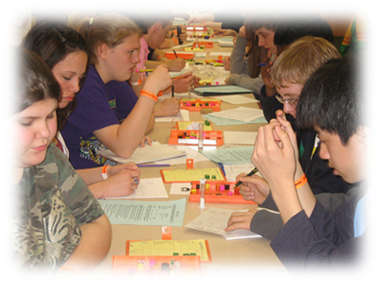
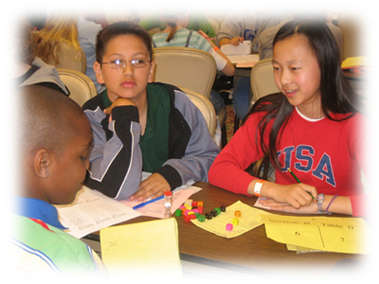
AGLOA provides a series of Academic Games competitions throughout the nation resulting in a National Championship Tournament in late April each year. Students who excel academically have a chance to compete and be rewarded for their accomplishments.
Academic Games tournaments challenge students to use higher order thinking skills in the subjects of Language Arts, English, History and Mathematics. Players receive recognition and awards in the same way that sports champions are honored.
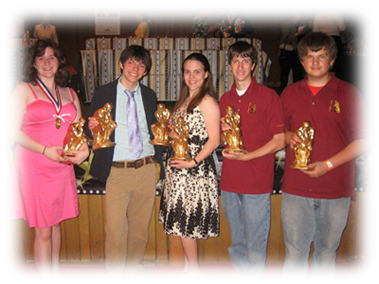
Academic Games
We support:
UNICEF – where every child has a fair chance in life.
Sherman Indian Museum – in Riverside, CA.
CA Safe Schools Coalition – protecting students from harassment based on sexual orientation.
USA Today Educate – teaching guides for teachers and students.
Play games for free with the no deposit bonus codes at https://nodepositpromocodes.com.
Do you know who was President when the U.S. entered World War II?
Do you know which President saved our National forests?
PRESIDENTS players KNOW!
You can learn and play PRESIDENTS and qualify for the National Tournament!
PRESIDENTS is played in FOUR Ranges.
Simple Rules of Play
For each question, you will be given 3 Clues to the identity of one of the Presidents in the Range.
If you choose to answer after the 6 point Clue, you win 6 points for a correct answer.
If you wait until you have read the 4 point Clue, you win 4 points for being correct.
If you wait until you have read the 2 point Clue, you win 2 points for being correct.
You may answer only once for each set of Clues.
If you answer incorrectly, you score 0 points.
Only one Range (1/4 of the presidents) is played at a time.
For each presidential range, there is a Gazeteer Chart of information, which you may view at any time during the question. Click on the range of your choice to see and study the Gazeteer Chart.
Range 1 includes the following 12 presidents:
1
George Washington
Lived 1732-1799
Born in Virginia
Died in Virginia
President 1789-1797
Party: None
2
John Adams
Lived 1735-1826
Born in Massachusetts
Died in Massachusetts
President 1797-1801
Party: Federalist
3
Thomas Jefferson
Lived 1743-1826
Born in Virginia
Died in Virginia
President 1801-1809
Party: Democrat-Republican
4
James Madison
Lived 1751-1836
Born in Virginia
Died in Virginia
President 1809-1817
Party: Democrat-Republican
5
James Monroe
Lived 1758-1831
Born in Virginia
Died in New York
President 1817-1825
Party: Democrat-Republican
6
John Quincy Adams
Lived 1767-1848
Born in Massachusetts
Died in Washington, D.C.
President 1825-1829
Party: Democrat-Republican
7
Andrew Jackson
Lived 1767-1845
Born in South Carolina
Died in Tennessee
President 1829-1837
Party: Democratic
8
Martin Van Buren
Lived 1782-1862
Born in New York
Died in New York
President 1837-1841
Party: Democratic
9
William Henry Harrison
Lived 1773-1841
Born in Virginia
Died in Washington, D.C.
President 1841-1841
Party: Whig
10
John Tyler
Lived 1790-1862
Born in Virginia
Died in Virginia
President 1841-1845
Party: Whig
11
James Polk
Lived 1795-1849
Born in North Carolina
Died in Tennessee
President 1845-1849
Party: Democratic
12
Zachary Taylor
Lived 1784-1850
Born in Virginia
Died in Washington, D.C.
President 1849-1850
Party: Whig
PROPAGANDA players can!
You can learn and play PROPAGANDA and qualify for the National Tournament!
PROPAGANDA is divided into six sections. We suggest that you start with Section C or D.
Read the definitions of the different techniques in a section.
Only one section is played at a time.
Section A: You can Fool Yourself.
Section B: Language will Lure You.
Section C: How Gullible are You?
Section D: What’s Your Weakness?
Section E: The Form will Fool You.
Section F: Maneuvers will Mess with You.
Articles
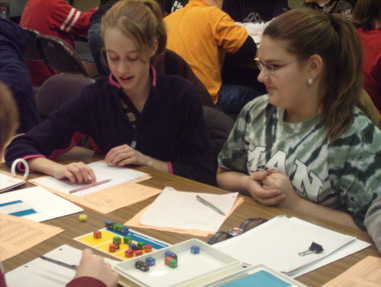
Basic Equations Rules
Basic Equations can be introduced with the following seven rules. The complete set of the Official Tournament Rules should be used once players become familiar with the game. I. GOAL Rule Two- or three-player matches will be played. To start, one player rolls 24...
World Events
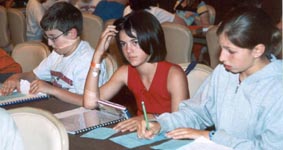
What Do Players Learn? While preparing for and playing WORLD EVENTS, players learn about the major political and cultural events of the most recent calendar year. They learn to be aware of what is happening to them, their country, and their world. In addition, players...
Equations Variations
Elementary Equations® Variations Note {counting numbers} = {natural numbers} = {positive integers} = {1, 2, 3, 4, ...} {whole numbers} = { 0, 1, 2, 3, 4, ...} GENERAL RULE If * is used for raising to a power, both base and exponent must be whole...
Glossary of Terms for On-Sets
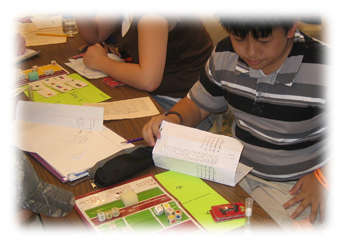
Additional minute The extra 60 seconds a player receives to complete what he must do after the first time limit has expired; by the end of this extra minute, the player must complete the action or receive a second -1 and forfeit what he is doing Advanced...

Propaganda Definitions
LinguiSHTIK
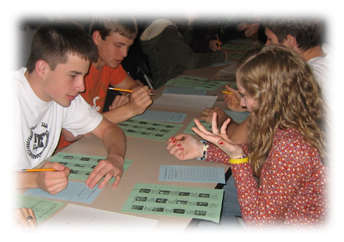
What do Players Learn? LINGUISHTIK challenges players to improve their grammar, vocabulary, spelling, and writing skills. Players learn to compose better sentences with proper grammar application. They also use richer vocabulary as they compete against others and are...
Equations
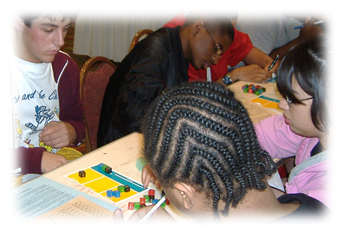
What Do Players Learn? EQUATIONS is the Game of Creative Mathematics. EQUATIONS involves authentic learning experiences and problem solving at the highest levels. All grade levels play with the same set of procedural rules. However, each division level of competition...
Play Propaganda
If you have read the definitions for a section, you are now ready to play PROPAGANDA. The rounds are set up just as they are for real competition, complete with a timer for each question. For these practice rounds the timer may be stopped so that you can reread the...
Learn On-Sets
What Do Players Learn? This game is very valuable in teaching about spatial relationships. The mathematical content of the game is Set Theory. Players learn to create and describe sets of colored objects using Union, Intersection, Set Difference, Set Complement, the...
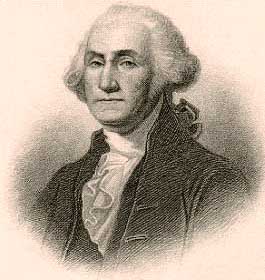
Play Presidents
You are now ready to play PRESIDENTS. The rounds are set up just as they are for real competition, with a timer for each question. A round contains ten questions. For these practice rounds the timer may be stopped so that you can review the gazeteer if needed. Only...